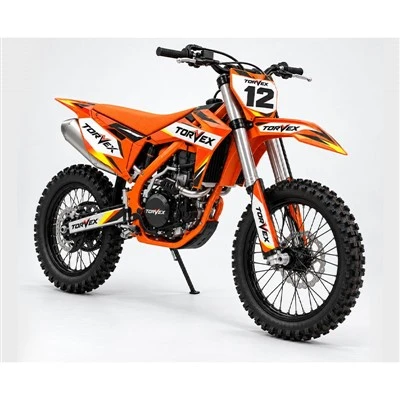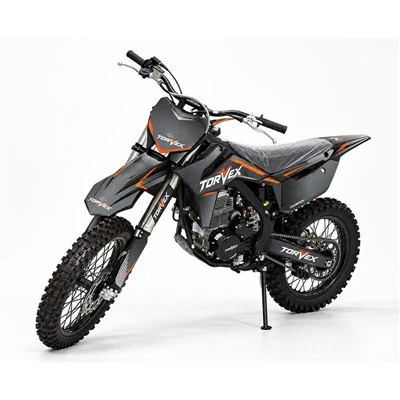

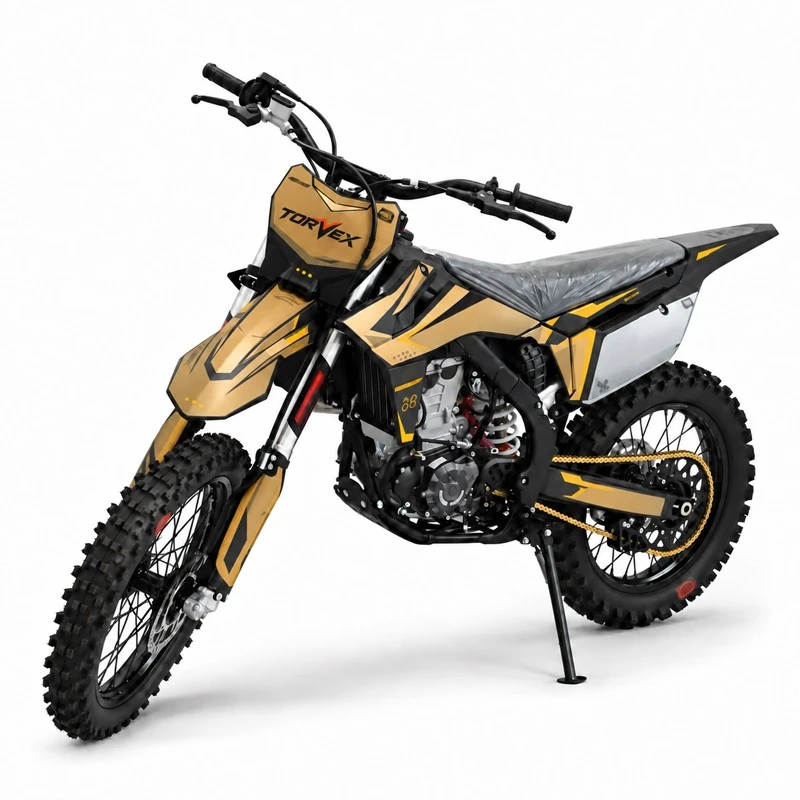
Shandong Tuowei Locomotive Co., Ltd. is one of the most reliable manufacturers and suppliers of 300cc motocross dirt bike in China. With a professional production team, we are able to meet the needs of the majority of our customers. Welcome to wholesale premium 300cc motocross dirt bike made in China here from our factory.
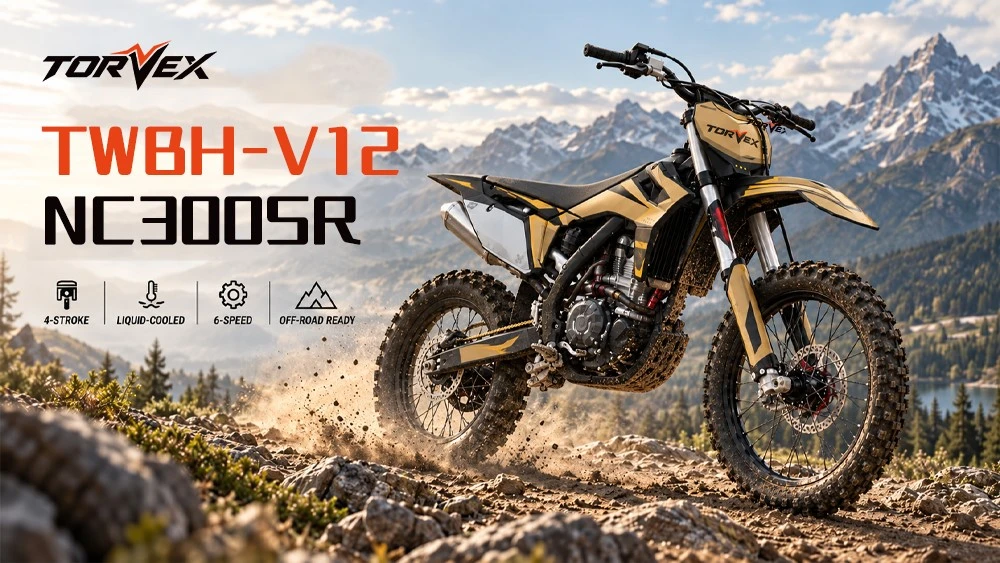
A 300cc Motocross Dirt Bike is a closed-course competition motorcycle built around a roughly 300cc four-stroke single-cylinder engine and a chassis developed specifically for motocross tracks. It differs from an enduro or dual-purpose machine in one fundamental way: nothing is carried that does not improve lap times. There are no lighting looms, no road homologation hardware and no soft touring suspension - every component is specified for acceleration, jump stability and repeated hard landings. The Torvex V12S-NC300SR follows this discipline, offering a race-oriented 300cc platform that is equally practical for training schools, rental fleets and private riders who want competition-grade hardware.
Engine and Drivetrain: A Powerband You Can Hold
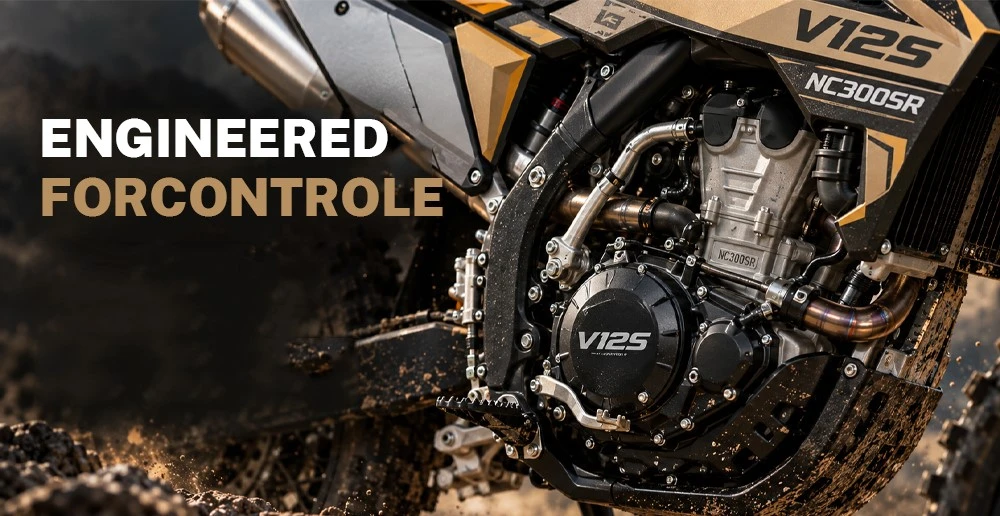
The engine is a liquid-cooled, four-stroke single of approximately 300cc, tuned for a wide, usable spread rather than a narrow peak. That distinction matters on a motocross track: a machine that only delivers at maximum rpm forces constant clutch work and gear changes, which costs time and tires the rider out. A broad powerband lets the rider roll the throttle out of a rut or a sand section in the same gear, keeping the chassis settled and the rear wheel hooked up.
Drive goes through a six-speed transmission with a manually operated clutch, and the gear ratios are spaced to keep the engine inside its strongest range between corners. Electric starting combined with a backup kick-starter means a stalled bike on the track or in a training session is restarted in seconds instead of being pushed off the circuit - a detail fleet operators notice immediately. A sealed O-ring chain and a reinforced clutch assembly handle the load spikes generated by hard launches and repeated jumps.
Chassis Geometry and Mass Centralisation
The frame is a high-strength steel perimeter structure paired with an aluminium rear swingarm. Steel is used deliberately in the main structure because it tolerates the flex and impact of off-road use better than a full alloy competition frame, while the aluminium swingarm reduces unsprung mass at the rear so the shock can control wheel movement more accurately. Components such as the fuel tank, airbox and exhaust are positioned close to the machine's centre, a practice known as mass centralisation.
The practical benefit is that direction changes require less rider effort. A bike whose mass sits centrally flicks from one berm to the next with less inertia to overcome, which is why riders often describe a well-balanced motocross dirt bike as feeling lighter than its published dry weight suggests. Generous ground clearance and a competition seat height give the rider room to shift weight forward over the front wheel or back over the rear without the chassis grounding out on jump faces or rutted sections.
Suspension Tuning for Real Track Conditions
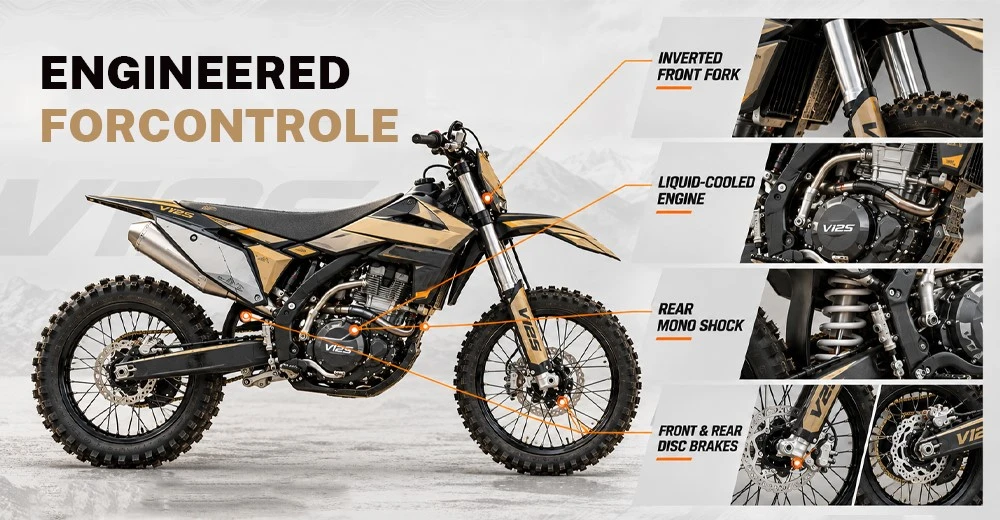
Long-travel suspension is the single biggest reason a purpose-built racing dirt bike outperforms an adapted trail machine. Up front, an inverted cartridge fork with adjustable compression and rebound damping absorbs braking bumps and the landing impact of tabletop jumps. Because the fork's larger diameter tubes increase bending stiffness, steering input reaches the front wheel with less deflection, so the rider gets more accurate feedback about available traction.
At the rear, a linkage-mounted monoshock with adjustable preload and damping controls how the bike squats under power and how it recovers between hits. Preload adjustment is what allows one model to serve riders of different body weights: setting sag correctly keeps the chassis in the middle of its travel, where the suspension has room to absorb both bumps and landings. For fleet buyers running riders with a wide weight spread, this adjustability removes the need to stock multiple chassis specifications.
Braking and Wheel Package
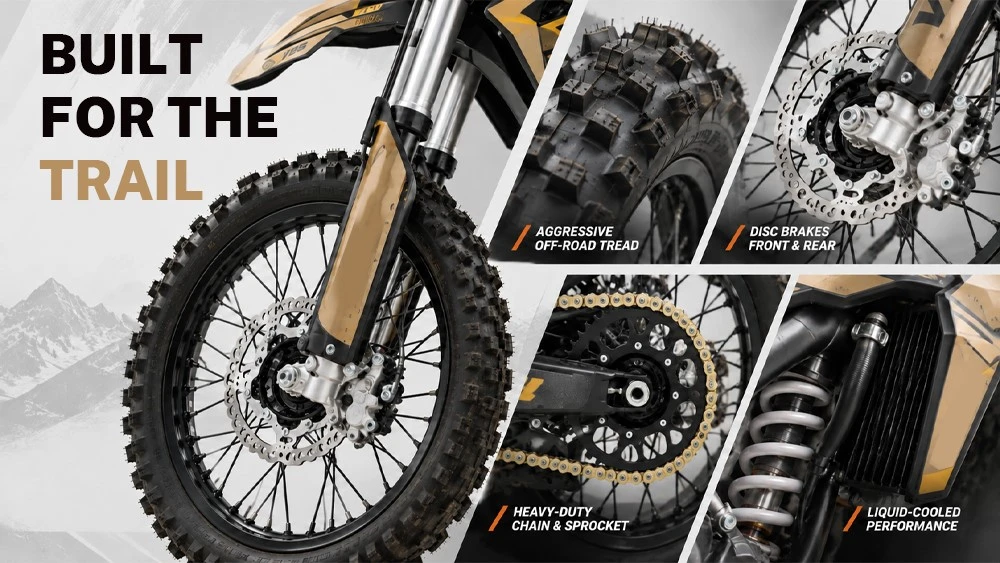
Stopping is handled by hydraulic disc brakes front and rear. Disc systems are specified over drum designs because they shed mud and water quickly and maintain consistent lever feel as temperatures rise during a long moto - a drum brake's efficiency drops noticeably once the lining is wet or contaminated. The oversized front rotor provides the initial bite needed to scrub speed before a corner entry, while the rear brake gives riders the control to settle the chassis mid-air or pivot the bike in tight turns.
The wheel package uses a 21-inch front and 18-inch rear combination wearing knobby competition tyres. The large front wheel rolls over ruts and square edges instead of deflecting off them, and the tall sidewalls provide additional cushioning. The tread pattern is designed to self-clean in loam and sand so grip does not disappear after a single muddy lap.
Serviceability: Where Operating Cost Is Won or Lost
Race bikes are judged over a season, not over a single weekend. This off road motorcycle is engineered with maintenance access in mind: the air filter can be reached without dismantling the fuel tank or rear bodywork, and the seat and side panels come off with a small number of fasteners. For a rental or training operation, that turns a job that might otherwise occupy a mechanic for an hour into a routine pre-ride check.
Wear items - brake pads, chain and sprockets, tyres, filters, control cables - use widely available specifications, and we supply original spare parts alongside the machines. Standardising consumables is what keeps a fleet running through a busy season instead of waiting on long-lead special orders, and it is the reason many distributors evaluate a dirt bike racing platform by its parts availability as much as by its horsepower.
Typical Applications
Closed-course motocross and amateur racing
01
Off-road training camps and rider coaching programs
02
Trail riding, ranch and farm commuting
03
Mountain patrol and forestry inspection routes
04
Scenic-area rental fleets and off-road event operations
05
Key Specifications
|
Available Colors |
White, Orange, Red, Silver |
|
Engine |
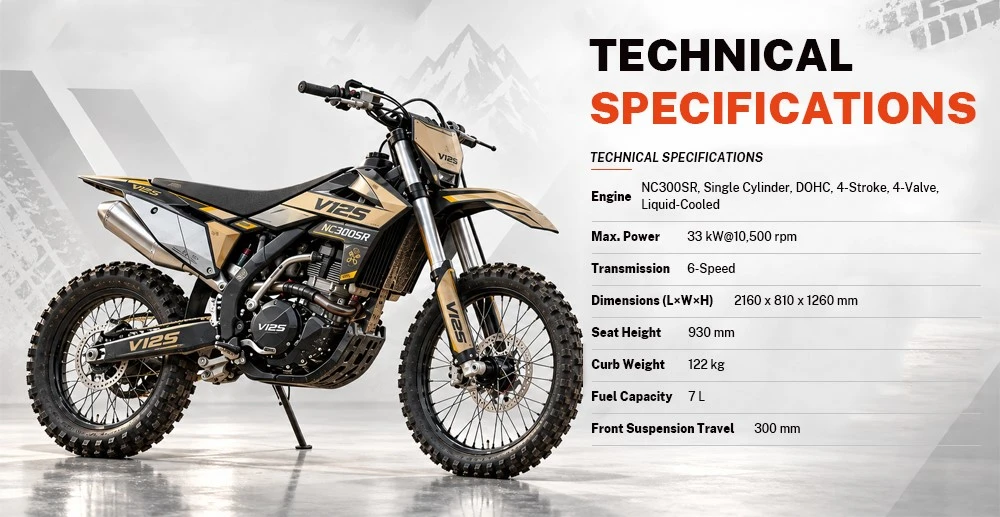
300cc 4-stroke single-cylinder |
|
Suspension |
Steeple geometry with firm damping and adjustable rear shock |
|
Wheels/Tires |
Race wheel set built for square-edge landings |
|
Brakes |
High-performance hydraulic disc brakes |
|
Other |
Sealed airbox, quick-access air filter, compact fuel tank |
|
Motocross-specific ergonomics, no road equipment |
|
Call to Action

Searching for a 300cc dirt bike for sale that can handle both race weekends and commercial duty cycles? Work directly with the factory. Torvex delivers competitive wholesale pricing, OEM/ODM customisation, original spare parts supply and dependable production schedules for bulk orders. Send us your target displacement mix, colour requirements and annual volume - our export team will return a detailed quotation, a full specification sheet and a recommended spare parts package, or arrange a live video walkthrough of the assembly line.
FAQ
Q: Who is this 300cc motocross bike built for?
A: It suits intermediate to experienced adult riders, club racers and commercial operators. Compared with a smaller machine it offers stronger mid-range pull and better stability at speed; compared with a large-displacement race bike it is easier to control over a full moto, which makes it a common choice for training fleets.
Q: Is the bike road legal?
A: This model is configured for closed-course and off-road use, so it is not supplied with road homologation equipment such as lighting, indicators or mirrors as standard. Because regulations differ by country, tell us your destination market and we will advise which configuration is appropriate for local registration requirements.
Q: Can suspension be set up for different rider weights?
A: Yes. The fork and rear shock offer damping adjustment, and the rear shock has preload adjustment so sag can be set correctly for riders of different weights. We provide baseline settings with each shipment, and our technical team can give remote guidance on sag measurement and clicker adjustment.
Q: Do you provide spare parts and after-sales support?
A: We supply original supporting spare parts, including consumables and core components, along with parts catalogues for bulk orders. A technical team is available around the clock for remote assistance with assembly, fault diagnosis, routine maintenance and parts replacement.
Q: What customisation options are available?
A: We support OEM and ODM requirements including colour matching (white, orange, red, silver, gold), accessory combinations, decal design and logo application. As a China-based 300cc dirt bike supplier, we can also discuss specification changes to suit your local climate, terrain and price positioning.
Q: How is quality controlled before shipment?
A: Each finished motorcycle undergoes end-of-line testing covering engine performance, braking system, electrical circuit and simulated road running. Production progress, inspection results and container loading are tracked and reported to the buyer, so every batch leaves the factory to the same standard.
Hot Tags: 300cc motocross dirt bike, China 300cc motocross dirt bike manufacturers, suppliers, factory